Template Types

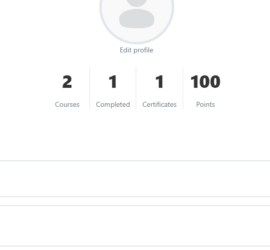
Customizing the LearnDash User Profile Course List
LearnDash provides the ability to template your LMS posts and shortcodes. In this post, I’ll only cover how to add a thumbnail image to your LearnDash [ld_profile] Course List, but you can also extrapolate this idea and use it in your Lesson and Topics lists using the same concepts documented here. There are 2 methods you can use to modify the Course List in the [ld_profile] shortcode. In this tutorial we’ll first cover this process using method 1 alone. Method 1, is the most native method to LearnDash and does not involve other plugins be installed. First, let’s briefly describe what a child-theme is and why you might want to use a child-theme over a code snippet. Simply put, a child-theme is a WordPress theme.
How to add different TABS to individual LearnDash posts
LearnDash lets you create tabs in their different post types. Their post types are course, lesson, topic, and quiz and you can add different tabs to any or all these post types. To accomplish this, you can either use a code snippet plugin or you can add a child-theme to your site and add code into that, but no matter how you accomplish this, you’re going to be adding code if you want to do this for free. Below is a fully functional PHP code example that adds custom TABS on a post-by-post basis in LearnDash post types.These posts have ID numbers for each one.These are the post ID’s you will see in the code be and will want to change to match your own
A Learning Ecosystem you’ll Dream About
We’ve all heard the innovation adage, “think outside the box”. It’s a cliché about breaking the paradigm of your thinking, but it also serves well as a metaphor if the box is your learning management system (LMS). Most organisations I have worked with try only to advance their learning innovation within the boundaries that their LMS sets. The latest and greatest learning experience is generally bound by the feature set the LMS supports. Learning designers are told to “get creative, just don’t break out of that box that is our LMS capabilities”. Every now and then, a project might start with a courageous sponsor trying to “do something different” but invariably they don’t have the organisational clout, stamina, or budget to beat down those walls.
Are you selecting the right LMS?
A Learning Management System, when selected and implemented correctly, will provide a lasting positive impact on both your business and your students. There are a great deal of things you want to consider when selecting, configuring, styling and implementing an LMS. Once you select an LMS and dive into creating courses, it’s often very hard to dig your way back out after dedicating time, resources and money toward your choice, so you cannot take your selection lightly, you really need to plan in advance. I’ve compiled a list of the most important questions you need to answer before identifying you actually need an LMS: What do you expect to get from a website? Who is your audience? What type of information do you want to
xAPI: An organisational game changer
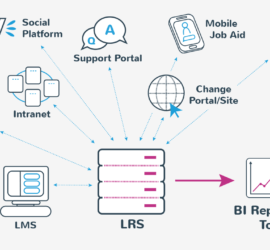
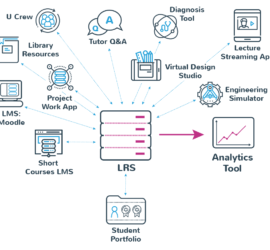
If you think xAPI is a pain because it needs an LRS, think again. Stop limiting your imagination and think of the bigger picture. Imagine, your a small (even individually owned and operated) company doing what you’re doing today. Now imagine being able to harness the power of large organizations that have massive budgets. You can do this, your not to small and your budget is not to limited. Even an individual entrepreneur can look really BIG on the web! Take a look at this WordCamp Montreal 2018 presentation I had given. It was so important to WordPress (Automattic) and Matt Mulenwig (the CEO of WordPress) that they sent their Sensei (the LMS that Automattic built and sells) Product Manager to my presentation. Their Product
Change Management in Learning Development
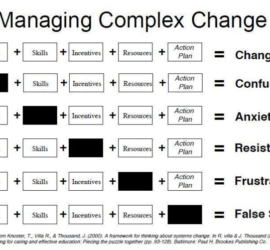
VISION + SKILLS + INCENTIVES + RESOURCES + ACTION PLAN = CHANGE Any good strategic planning process will address each of these, but implementing each one consistently over time is where things can get tricky. This framework shows what it can feel like in an organization when any one of these 5 elements is missing. As you can see in the notes above, this model is credited to Knoster, Villa and Thousand (2000). It has been used in a variety of educational settings, and it’s widely applicable to any number of contexts. What I love about this model is that it distills some intertwined factors in a clear framework. Every group I have worked with who has seen this gets it. I like to use

Smart Ways to Personalize an LMS
Last month I was asked by the eLearning Guild to contribute to a white paper by Susan Jacobs. I later found out that Adobe and the eLearning Guild were critiquing my input. I’m happy to say they accepted my input along with a few course developers and they published the paper on 6 July, 2017. You can download the official copy of the white paper here: https://www.elearningguild.com/publications/index.cfm?id=112&from=home I’ve also added the pre-official release here for your reference.
What is a competency?
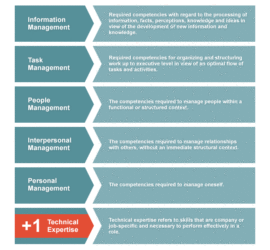
A competency is the capability to apply or use a set of related knowledge, skills, and abilities required to successfully perform “critical work functions” or tasks in a defined work setting. Competencies often serve as the basis for skill standards that specify the level of knowledge, skills, and abilities required for success in the workplace as well as potential measurement criteria for assessing competency attainment. The difference between a competency and a learning objective: Competencies define the applied skills and knowledge that enable people to successfully perform their work, while Learning Objectives are specific to a course of instruction. Competencies are relevant to an individual’s job responsibilities, roles and capabilities. Competencies are a way to verify that a learner has in fact learned what was intended

Tracking Augmented Reality events
Often, I perceive the end-goal of TIN CAN Learning in the Just-In-Time (JIT) form. The scenario I usually provide is of a person learning to operate a new type of industrial vehicle (a skill based learning) where the learner has already completed a knowledge based training session where they learned the operational theory and maintenance related tasks to be performed.
Learning Management Systems – Everything you already know
This is a big topic, so be prepared to fall asleep in the process. This first post, describes everything you ever wanted to know about SCORM. We could discuss AICC (the predecessor to SCORM), but that goes back to the 90’s (as you will later see) and is most likely no longer used anywhere today. A Learning Management System (LMS) provides management and learners with results based information. In the future, you should expect more from your LMS. The type of information we get today varies based on many factors, is usually generated around organizational requirements and, is restricted by the type of LMS we use as well as any customizations we’ve had to make to it. Let’s take a look at the most popular
Are we driving the learning industry?
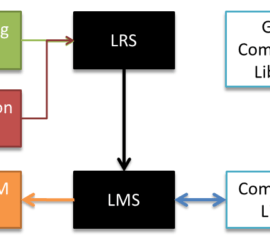
How often have your tried to report something from your course, only to find it cannot do it “out-of-box”?
Chances are you simply can’t do it.